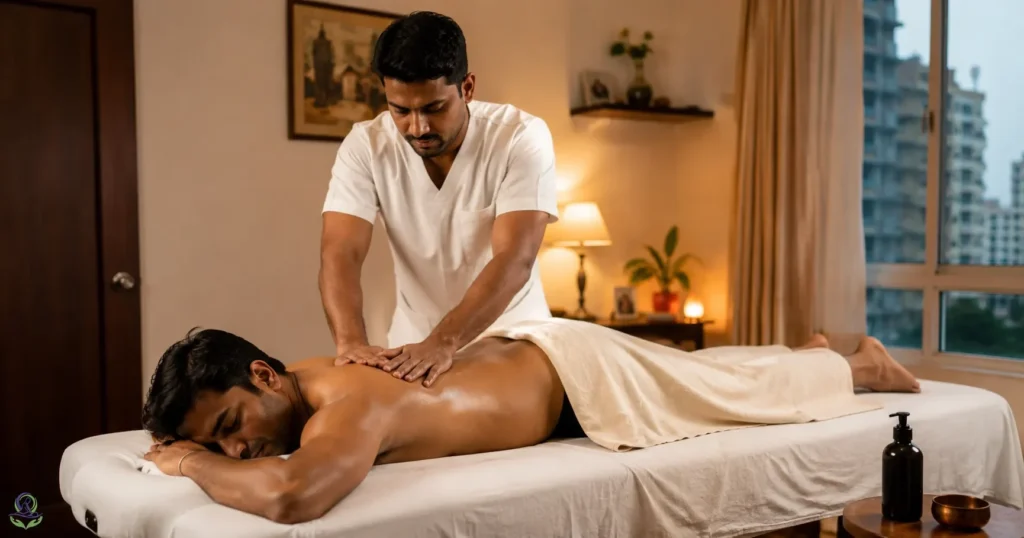

Deep tissue massage vs Swedish massage is one of the most common comparisons people make before booking a professional massage at home in Mumbai.


You have finally decided to book a professional massage at home in Mumbai. You open the booking page, you see the options – Swedish massage, deep tissue massage – and then you pause. Which one do you actually need?
It is one of the most common questions Homecare Therapy receives, and it is a genuinely important one. Booking the wrong type of massage is not just a missed opportunity – it means you spend money and an hour of your time getting something your body did not actually need, while the real problem goes unaddressed.
The internet is full of vague answers to this question. “Swedish is for relaxation, deep tissue is for pain.” That is technically true but almost completely useless as guidance for someone trying to make an informed decision.
The real answer is more nuanced – and more interesting. The right massage for you depends on what is happening in your body right now, what you are trying to achieve, how much tension you are carrying, whether your pain is acute or chronic, and even how long it has been since your last professional massage session.
This guide gives you the complete, honest picture. By the time you finish reading, you will know exactly which massage is right for you, when to switch between them, and why Mumbai professionals who understand their bodies book different types at different times depending on what they need. We will also cover what each massage feels like from the inside, what the research says about their respective benefits, common myths, safety considerations and how to get the most out of whichever type you choose when booking a home massage in Mumbai.
Deep Tissue Massage vs Swedish Massage - Key Differences
Before comparing the two, it helps to understand what each massage is actually doing to your body – not just the surface description, but the physiological reality of what happens when a trained therapist works on your muscles.
What Swedish massage is actually doing
Swedish massage works primarily on the superficial neuromuscular system. Its five core techniques – effleurage, petrissage, tapotement, friction and vibration – are applied at a pressure that reaches the outer muscle layers, the fascial covering of the muscles and the peripheral nervous system.
The primary target of Swedish massage is the nervous system – specifically, the shift from sympathetic (fight or flight) to parasympathetic (rest and recover) nervous system dominance. When a skilled therapist applies long, rhythmic effleurage strokes, the nervous system interprets these as a signal of safety and begins downregulating. Heart rate drops. Breathing deepens. Cortisol decreases. The muscles receive a neurological signal to release tension, rather than a purely mechanical instruction.
This is why Swedish massage can produce profound full-body relaxation even when the pressure used is relatively moderate. The effects are primarily neurological – and neurological effects are fast, systemic and felt throughout the entire body simultaneously.
Confused Between Swedish & Deep Tissue Massage?
Our certified therapists help you choose the right massage based on your pain points, stress level and body condition.
What deep tissue massage is actually doing
Deep tissue massage works primarily on the musculoskeletal system – specifically, on the deeper layers of muscle tissue, the tendons, the ligaments and the fascia that surrounds and connects all of these structures.
The techniques used in deep tissue massage – slow, deliberate strokes with sustained pressure, cross-fibre friction, trigger point therapy and myofascial release – are designed to physically manipulate tissue that is thickened, adhered, knotted or shortened from chronic tension or injury. The therapist is, in a very real sense, doing mechanical work on the physical structure of your muscles.
This means deep tissue massage requires more time to produce its effects, can feel more intense in the short term and targets specific, localised problems rather than the body’s global stress state. The changes it produces are structural – releasing adhesions between muscle fibres, breaking up scar tissue, restoring blood flow to compressed tissue, elongating shortened muscle groups – rather than primarily neurological.
Understanding this difference is the key to choosing correctly. Swedish massage changes how your nervous system is operating. Deep tissue massage changes the physical condition of your muscle tissue. Both are valuable. They are just valuable for different things.
Swedish Massage Benefits & When to Choose It
Who benefits most from Swedish massage
Swedish massage is the right choice when:
You are dealing primarily with stress, mental fatigue, anxiety or a general sense of being overwhelmed. When the problem is in your nervous system – when you feel wound up, tightly strung, unable to switch off – Swedish massage addresses the root cause directly.
You have not had a professional massage in a long time, or this is your first session. Jumping straight into deep tissue work on muscles that have been carrying chronic tension for months can be counterproductive – the muscles contract defensively against intense pressure if they have not been warmed and prepared. A Swedish massage session first establishes the nervous system and muscular baseline that makes deep tissue work more effective in subsequent sessions.
You are dealing with mild to moderate muscle tension that is primarily stress-related rather than structurally embedded. The desk worker whose shoulders are tight from today’s stressful deadline will respond beautifully to Swedish massage. The desk worker whose shoulders have been tight every single day for three years has a different problem that may need deep tissue work.
You want a thorough, full-body experience that covers every major muscle group in a single session. Swedish massage is designed as a complete, systematic full-body treatment. Deep tissue massage, by contrast, typically focuses on specific problem areas and cannot cover the whole body in the same depth within 60 minutes.
You are recovering from illness, feeling generally depleted or going through a period of emotional difficulty. Swedish massage supports immune function, improves sleep and provides the kind of restorative, caring physical experience that helps people feel genuinely looked after – something that has genuine therapeutic value beyond the purely physical.
You are pregnant and need adapted massage therapy. With appropriate modifications, Swedish massage is the safest and most suitable form of massage during pregnancy.
What a Swedish massage session feels like
The session begins with broad, warming effleurage strokes across the back. The pressure is confident but gentle – like a slow, deliberate wave passing through the muscle. Within the first five minutes, most people notice their breathing becoming slower and deeper. This is the parasympathetic shift beginning.
As the session progresses and the therapist works through the shoulders, neck, arms, legs and feet, the sense of relaxation deepens progressively. Many clients describe a feeling of the body becoming heavier – as if they are sinking comfortably into the surface beneath them. This heaviness is not tiredness. It is the release of the chronic muscular holding that most people carry without realising it.
By 30 to 40 minutes into a Swedish session, it is extremely common for clients to drift into a light, restful sleep-like state – not fully unconscious, but deeply calm and barely aware of the external world. This is, neurologically speaking, exactly what a successful Swedish massage session looks like. The nervous system has fully downregulated.
After the session, most clients feel simultaneously deeply relaxed and physically lighter. Movement feels easier. The jaw – which most people hold tightly without realising – feels loose. The shoulders sit lower. Breathing is noticeably deeper.
Swedish massage at home in Mumbai – pricing and availability
Swedish massage at home in Mumbai with Homecare Therapy starts at ₹1,299 for 60 minutes and ₹1,599 for 90 minutes. The 90-minute session is particularly recommended for first-time clients, as it allows sufficient time to properly address the full body without rushing.

Deep Tissue Massage Benefits & Best Use Cases
Who benefits most from deep tissue massage
Deep tissue massage is the right choice when:
You have a specific, identifiable area of chronic pain or tension that has been present for weeks, months or longer. A knot in the left shoulder that never fully goes away. A band of tightness across the lower back that is there every morning when you wake up. Tightness in the IT band from running that has been affecting your stride. These are structural problems embedded in the physical tissue – and they need structural solutions.
You have tried Swedish massage and found that while you felt relaxed during and immediately after the session, the specific areas of pain or tension returned quickly. This is a strong signal that the problem is deeper than Swedish techniques can adequately address.
You are an athlete or physically active person dealing with muscle recovery, performance optimisation or injury rehabilitation. Deep tissue massage is the standard of care in sports medicine for a reason – it directly addresses the mechanical problems that accumulate in muscles under heavy training loads.
You have poor posture from years of desk work and want to address the underlying muscular imbalances – shortened hip flexors, tight chest muscles pulling the shoulders forward, compressed lower back extensors – that are causing the posture problem. Postural correction requires structural work on chronically shortened tissue, which is exactly what deep tissue massage provides.
You have a specific diagnosis – a muscle strain, plantar fasciitis, rotator cuff tightness, sciatica triggered by piriformis syndrome – that would benefit from targeted, therapeutic pressure on the affected structures.
What a deep tissue massage session actually feels like
This is where a lot of confusion and unnecessary anxiety exists – so let us be very clear.
Deep tissue massage is not painful. A good deep tissue therapist is not someone who simply pushes as hard as they can. The goal of deep tissue work is to reach the deeper layers of muscle and connective tissue through sustained, progressive pressure that the tissue gradually yields to – not to force their way in through brute strength.
What deep tissue massage feels like from the inside is a productive, working pressure – more intense than Swedish, but always within a range that your body can accept without tensing defensively. Many clients describe it as feeling like the therapist is finding the exact right spot and the body is responding with a sense of relief and release. There is often a sensation of something unwinding or letting go as a knot releases.
There should never be sharp pain, burning or a sensation of something tearing. If you experience any of these, you should tell your therapist immediately – the pressure needs to be reduced.
It is normal to feel some tenderness in intensely worked areas for 24 to 48 hours after a deep tissue session – similar to the productive soreness you feel after a good workout. This is the tissue responding to therapeutic work and is not a cause for concern. Staying well hydrated after a deep tissue session significantly reduces post-session soreness.
Deep tissue massage at home in Mumbai – pricing and availability
Deep tissue massage at home in Mumbai with Homecare Therapy starts at ₹1,399 for a 60-minute session. Given the focused, intensive nature of deep tissue work, 60 minutes is the standard session length – it allows thorough work on the primary problem areas without fatigue for either client or therapist.

Deep Tissue Massage vs Swedish Massage Comparison Table
Factor | Swedish Massage | Deep Tissue Massage |
Primary target | Nervous system and superficial muscles | Deep muscle layers, tendons and fascia |
Pressure level | Moderate – firm but gentle | Firm to intense – targeted and sustained |
Primary goal | Full-body relaxation and stress relief | Structural release of chronic tension and pain |
Best for | Stress, anxiety, sleep, general wellness | Chronic pain, knots, injury recovery, posture |
Coverage | Full body, systematic | Focused on problem areas |
Session feel | Deeply relaxing, often drowsy | Productive working pressure, intensely focused |
Post-session feeling | Light, calm, sleepy | Relieved, sometimes mildly sore for 24-48 hrs |
How quickly you feel it | During the session | Fully felt 24-48 hours after the session |
Frequency recommended | Every 2-4 weeks for maintenance | Weekly initially for chronic issues, then monthly |
First-time clients | Ideal starting point | Better after at least one Swedish session |
Pricing at Homecare Therapy | From ₹1,299 (60 min) | From ₹1,399 (60 min) |
The most common myths about both massages - debunked
Myth 1: “Deep tissue massage is always better because it works harder”
This is probably the most widespread misconception about massage. Harder is not better – appropriate is better. If your primary problem is chronic stress and a wound-up nervous system, deep tissue work will not address the root cause as effectively as Swedish massage. You need the right tool for the right job. A surgeon does not use a larger scalpel because it seems more powerful – they use the instrument that the specific procedure requires.
Myth 2: “Swedish massage is just for pampering and has no real therapeutic value”
This is completely false, and it reflects a misunderstanding of what Swedish massage is actually doing physiologically. The cortisol reduction, immune system support, sleep improvement and cardiovascular benefits of regular Swedish massage are well-documented in peer-reviewed research. Describing Swedish massage as mere pampering is like describing sleep as mere laziness – it fundamentally misunderstands the biology.
Myth 3: “Deep tissue massage has to hurt to work”
No. Pain causes the muscles to contract defensively – which is the exact opposite of what you want when trying to release deep tension. If a deep tissue massage is causing sharp pain, the therapist is either using too much pressure, using incorrect technique or working on a contraindicated area. Productive, working pressure – yes. Pain – no, never.
Myth 4: “One session of deep tissue massage will fix my chronic back pain”
Chronic muscular problems – by definition – have been building for a long time. A single session will almost always produce noticeable improvement, but resolving a problem that has been embedded in the tissue for months or years typically requires a series of sessions. Think of it like physiotherapy – one session is a start, not a cure.
Myth 5: “Swedish massage does nothing for muscle pain”
Swedish massage absolutely reduces muscle pain – but it works on pain that is primarily caused by tension and restricted blood flow rather than deep structural problems. For mild to moderate muscle soreness and tension, Swedish massage is highly effective. For chronic, deeply embedded pain, deep tissue is the better choice.
Myth 6: “You should always start with deep tissue if you have any kind of pain”
Not necessarily. If you are new to massage, starting with deep tissue before your body has any experience of professional touch can be counterproductive. Your muscles do not yet know how to yield to sustained pressure, and the session can feel more intense than it needs to. Starting with one or two Swedish sessions first prepares the nervous system and the tissue for deeper work and makes subsequent deep tissue sessions significantly more effective.
When to combine both – the approach that experienced clients use
Here is something that the most experienced massage clients in Mumbai understand well: Swedish and deep tissue are not either/or choices. They are complementary tools that work beautifully together within a thoughtful wellness routine.
The most effective approach for most working professionals in Mumbai – particularly those dealing with both chronic stress and specific areas of muscular pain – looks something like this.
Month one, if you are new to massage: Two Swedish massage sessions spaced two weeks apart. This establishes a baseline of nervous system calm and begins releasing the superficial tension that has been accumulating. Your body learns to trust the process and to yield to professional touch.
Month two onward: Alternate between a Swedish and a deep tissue session each month. The Swedish session maintains the nervous system benefits, the sleep improvement and the full-body relaxation. The deep tissue session addresses the specific structural issues – the persistent lower back tightness, the shoulder knot, the hip flexor shortening – that need ongoing structural work.
When a specific acute issue appears – a new muscle strain, a stiff neck from sleeping awkwardly, post-training soreness – book the massage type most appropriate for that specific issue rather than automatically defaulting to your usual choice.
This alternating approach is why many of Homecare Therapy’s most loyal clients in Mumbai have been booking monthly for a year or more. They have discovered that the two modalities support each other – and that the cumulative effect of both on their body’s baseline is significantly better than either alone.
Special situations – which massage to choose
You are an IT professional with desk-related neck and shoulder pain
Start with: Swedish massage for the first one to two sessions to release the stress component and surface tension. Then add: Deep tissue work focused on the trapezius, levator scapulae and suboccipital muscles – the specific culprits in desk worker pain. Maintain with: Monthly sessions alternating between both types.
You are a runner or gym-goer dealing with muscle soreness and tightness
For post-training recovery: Swedish massage 24 to 48 hours after a hard session – improves circulation and clears metabolic waste without overwhelming tired muscles. For ongoing structural issues: Deep tissue every two to three weeks targeting the specific muscle groups under heaviest load in your training.
You are a new mother recovering after delivery
Choose: Swedish massage adapted for the postnatal body – gentle, warming and restorative. The focus is on the lower back, hips, shoulders and neck, which take the most physical strain in the weeks and months following delivery. Avoid initially: Deep tissue work until the body has had sufficient recovery time from delivery and any associated procedures.
You are a senior citizen dealing with joint stiffness and general aches
Choose: Swedish massage with lighter pressure – the improved circulation, gentle muscle warming and nervous system relaxation are highly beneficial for elderly bodies. Deep tissue work can be incorporated very selectively for specific areas of chronic tension, but should always be introduced gradually and gently.
You are dealing with high stress but also have a specific knot or area of chronic pain
The honest answer: Book a 90-minute Swedish session and ask your therapist to spend additional time on the problem area with slightly firmer pressure. A skilled therapist can work a single area with more depth within a Swedish session without fully crossing into deep tissue territory – providing some of the structural benefit while maintaining the overall relaxation focus of the session.
You are completely new to massage and not sure where to start
Choose: Swedish massage, every time. It is the universally recommended starting point for a reason. You will leave knowing what professional massage feels like, having established a baseline of trust with the process and with a much clearer sense of what your body responds to – which will inform every booking decision you make afterward.
How to communicate your needs when booking a home massage in Mumbai
One of the biggest advantages of booking home massage in Mumbai through Homecare Therapy is the ability to have a direct, specific conversation about your needs before the therapist arrives. This is significantly harder to do effectively when booking a spa slot online through a generic platform.
When you WhatsApp Homecare Therapy at 9433271738 to book, here is exactly what to communicate for the best possible session:
For Swedish massage: Tell the team if you have any specific areas of focus (shoulders, lower back), any pressure preferences (lighter touch, firmer pressure in specific areas) and any health conditions the therapist should know about before arriving.
For deep tissue massage: Be as specific as possible about the location and nature of your pain – which side, which exact area, whether it is constant or only with specific movements, how long it has been present, whether you have any diagnosis from a doctor or physiotherapist.
For a combined approach: You can request a session that begins with Swedish techniques to warm the tissue and then transitions into deeper work on specific areas – this is actually how many professional massage therapists prefer to work, as it produces better outcomes than going straight into deep pressure on cold muscles.
The clearer you are when booking, the more precisely your therapist can tailor the session – and the better your results will be.
Got a question?
Frequently asked questions about deep tissue vs Swedish massage in Mumbai
Making your decision - a simple guide
If you are still not sure after reading all of this, here is the simplest possible decision framework.
Choose Swedish massage if:
- Your primary complaint is stress, anxiety or being unable to switch off
- You have not had a professional massage in more than 3 months – or ever
- Your muscle tension feels general and widespread rather than localised
- You want a full-body session rather than focused work on specific areas
- You are recovering from illness or going through a demanding emotional period
- You are pregnant (with appropriate modifications)
- You are elderly and need gentle, adapted care
Choose deep tissue massage if:
- You have a specific, identifiable area of chronic pain that has been present for weeks or longer
- You have had Swedish massage before and know that specific areas need more targeted, structural work
- You are an athlete or physically active person dealing with training-related muscle issues
- You have posture-related pain from years of desk work
- A doctor or physiotherapist has recommended massage for a specific musculoskeletal condition
- You wake up with pain in a specific area every morning regardless of your stress levels
Book both – alternating monthly – if:
- You are a working professional in Mumbai dealing with both daily stress and specific areas of chronic tension
- You want the best possible long-term results from a consistent massage routine
- You have been receiving regular massage for more than two months and understand what your body responds to
Book your massage at home in Mumbai today
Whether you have chosen Swedish, deep tissue or decided that alternating between both is the right approach – the next step is the same. Homecare Therapy’s verified, certified therapists are available across Mumbai and Navi Mumbai, bringing everything needed for a professional session directly to your home.
Swedish massage from ₹1,299. Deep tissue massage from ₹1,399. Female therapists available on request. Background-verified professionals. Fresh disposable sheets. Transparent pricing with no hidden charges.
Over 500 Mumbai families already trust Homecare Therapy for their regular at-home massage sessions – with a 4.9-star Google rating across 106 verified reviews to show for it.
Your body knows what it needs. Now you do too.
Book your home massage in Mumbai now. Visit homecaretherapy.in or WhatsApp 9433271738. Same-day booking may be available – confirm your slot today.
Book Your Massage
Relax. Refresh. Rejuvenate.